
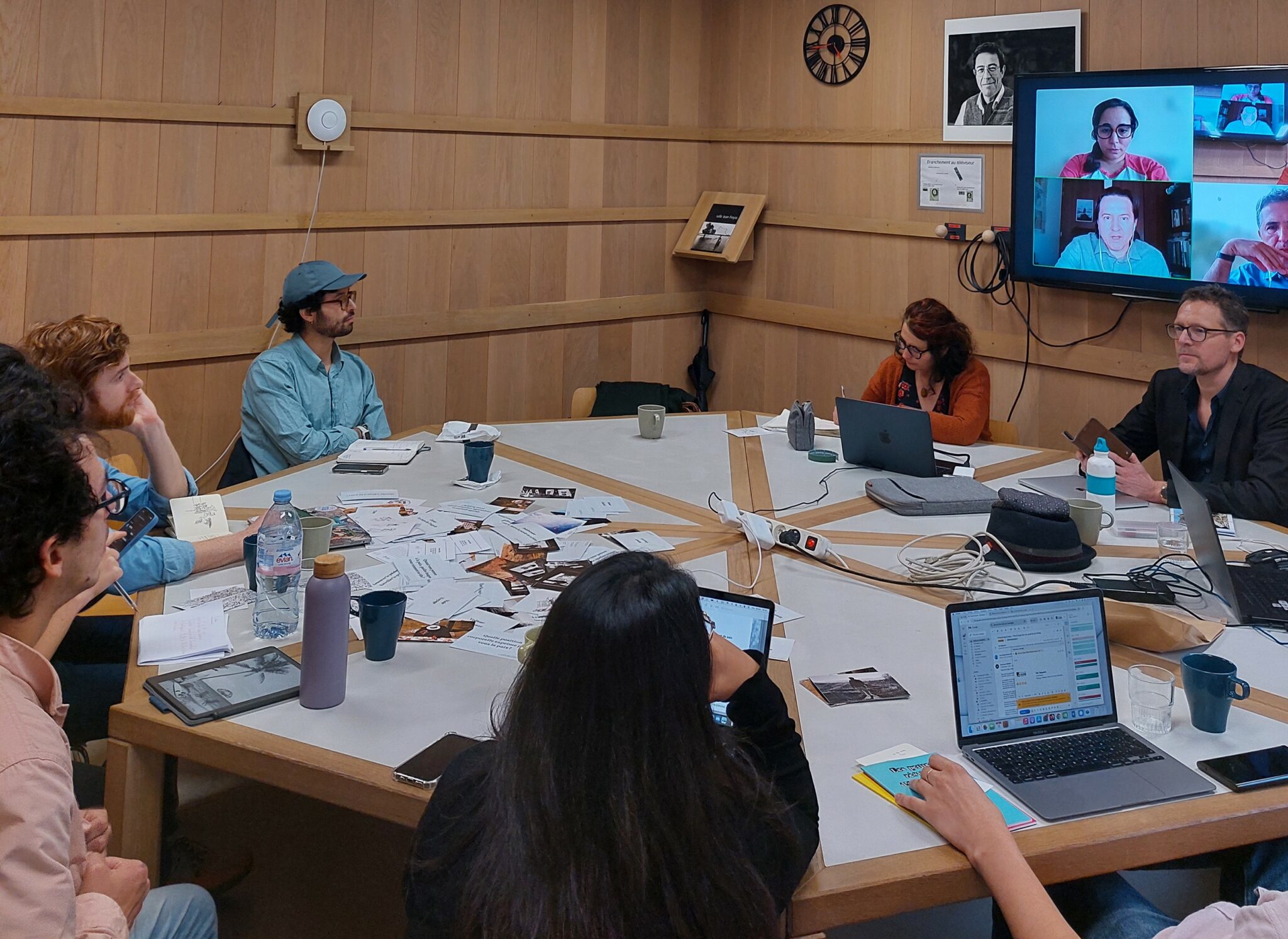
On Friday 18 and Saturday 19 October 2024, the study days “Constellations for Peace” were held in Paris. This event enabled the working group “Regional Approaches to Peace” to further refine its project to create a collaborative transmedia platform exploring the plural meanings of peace.
Exploring other ways of thinking about and practicing peace through visual, digital, and multimedia approaches.
This event, organized by the “Regional Approaches to Peace” working group of the Institut pour la Paix, was conceived as a space for collaborative reflection and creation, bringing together researchers, artists, and activists to explore new visual, sensory, and digital perspectives on the concept and lived experiences of peace.Through bodily exercises, project presentations, and participatory workshops, a range of reflections emerged on the importance of digitizing diverse concepts, practices, and experiences of peace, drawing on the research work of various members of the working group.
The body as an approach to the concept of peace
The first study day began with a breathing exercise and the evocation of personal memories and words related to peace and war, inviting participants to approach peace through the body, as a more affective and less theoretical perspective. From this experience, key methodological questions emerged (How can a chaotic peace be conceptualized?), rhetorical questions (Which changes faster, the world or the body?), and critical questions (Why do some conflicts hurt more than others?).This embodied approach enabled participants to reflect on peace as a plural and sensory phenomenon, rather than as a fixed, formal concept. They also reflected on the importance of destabilizing the notion of peace as something commemorative, often associated with silence, for example, in relation to the feminist slogan “Ni un minuto de silencio”. How, then, can peace be made with noise, shouting, or chaos?
Peace as a collective construction
The study day continued with presentations of various projects by researchers from the “Regional Approaches to Peace” working group, including Tania Romero Barrios with the project “Warmikuna”; Salima Cure and Laura Lema Silva with “Sanadurías”; Fernando Garlín Politis with “Poetry of Disarmed Arts”; and Leïla Ghadi-Larchevêque with “Memories of Nippo-American Migration.”This day also provided the opportunity to welcome the Director of the Institut pour la Paix, Thomas Hippler, who spoke about the history of images of peace. The different project presentations highlighted the importance of translating academic content into spaces of community participation and interdisciplinary collaboration in the construction of alternative meanings of peace that are relevant to the current context. In particular, emphasis was placed on the importance of creating creative participatory spaces through orality, testimonies, objects, art, and craft as complementary media to written forms.
Among the central themes addressed, the following were highlighted:
1. Memory as a means of transformation for peace
2. Art as a space for expression and collective healing
3. Technology as a participatory pedagogical tool
Participatory workshops
During the second study day, several practical workshops were organized, offering a space for experimentation and collective creation. Through sound-based, bodily, and narrative exercises, participants explored different dimensions of peace, such as sound, color, the body, and landscape.Overall, this study day enabled the “Regional Approaches to Peace” working group to highlight the potential of digital technologies to connect diverse experiences of resistance, struggle, and peace by amplifying peripheral voices. Regarding the future stages of developing the “Constellations for Plural Peaces” platform, the need to include multi-format content centered on local contexts and communities, with collaborative features and a strong pedagogical dimension, now appears evident.


.png)
